
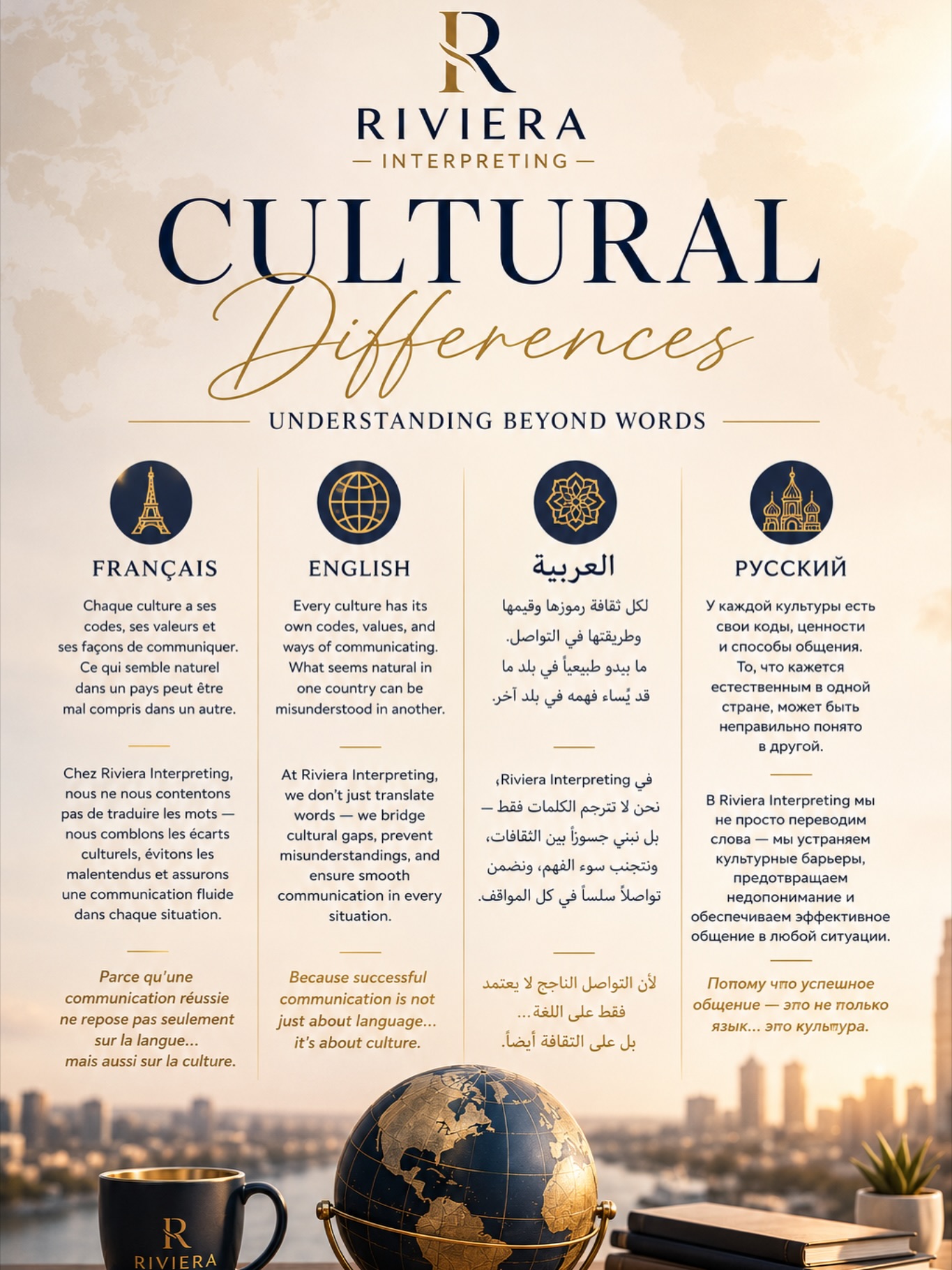

Most of the misunderstandings we see in meetings do not come from a mistranslated word. They come from a cultural code: a politeness taken for a commitment, a silence read as refusal, a "yes" that meant "I heard you".
Here is what ten years of interpreting between French, English, Arabic and Russian have taught us - and what an experienced interpreter corrects in real time.
The relationship to the contract
In French practice, the written word rules and negotiation ends at signature. In Gulf custom, the relationship precedes the document: a contract signed too fast, without time for trust, can read as a lack of regard. On the Russian side, written precision is prized, yet renegotiation remains conceivable if the context shifts.
An interpreter who knows these expectations paces the meeting - and stops one side pressing where the other needs time.
Saying no
A direct "no" is acceptable in French business, common in Russian, rare in Arabic where preserving the relationship comes first: an "inshallah" or "we shall see" can be a polite refusal.
Translating such formulas word for word misleads. An experienced interpreter renders the intention, not just the sentence - and flags to their client the nuance that would otherwise escape them.
Silence and time
A thinking silence is comfortable in some business cultures, heavy in others. Whoever breaks it too soon sometimes concedes without knowing. Likewise the clock: French punctuality to the minute, relational flexibility elsewhere. Warning your counterpart about these gaps avoids needless offence.
Hierarchy and the decision
Who decides, and when? In many Gulf and Russian companies the decision travels up to the principal, and the meeting serves to prepare - not to conclude. Expecting a signature at the end of the session is preparing your own disappointment. A briefed interpreter helps read those signals.
What an interpreter concretely changes
An experienced liaison interpreter does three things no app does: they render the intention behind the formula, they flag diverging codes, and they protect the relationship by smoothing what must be smoothed without ever altering the substance. Business dinners are where this shows most.
A multicultural meeting to prepare?
Describe the context: the nationalities around the table, the goal, the setting. We will tell you what preparation and which mode of interpreting fit.